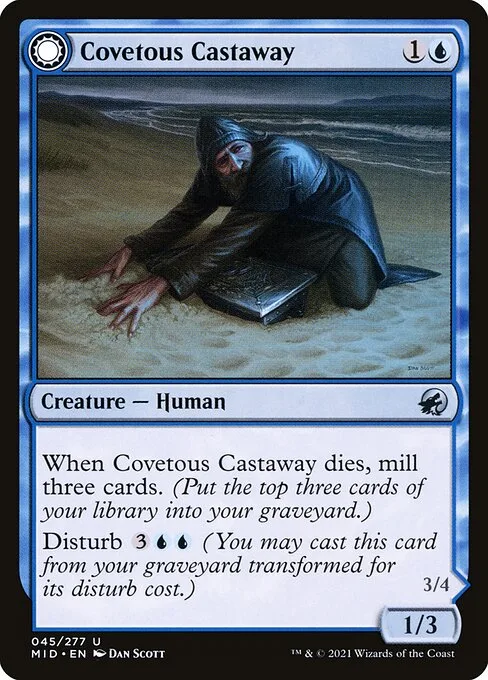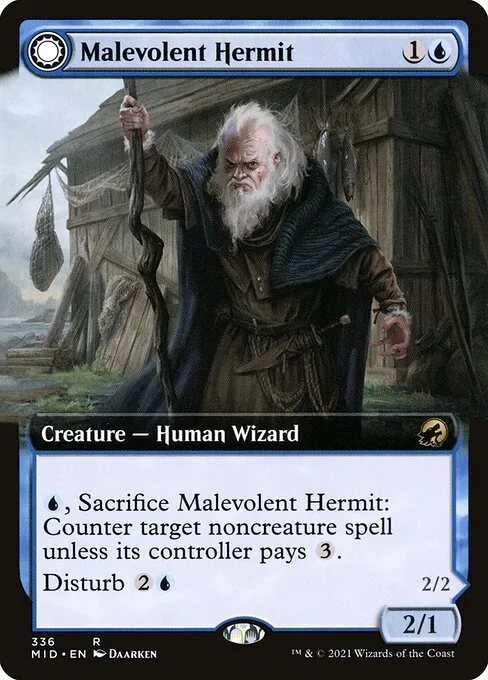
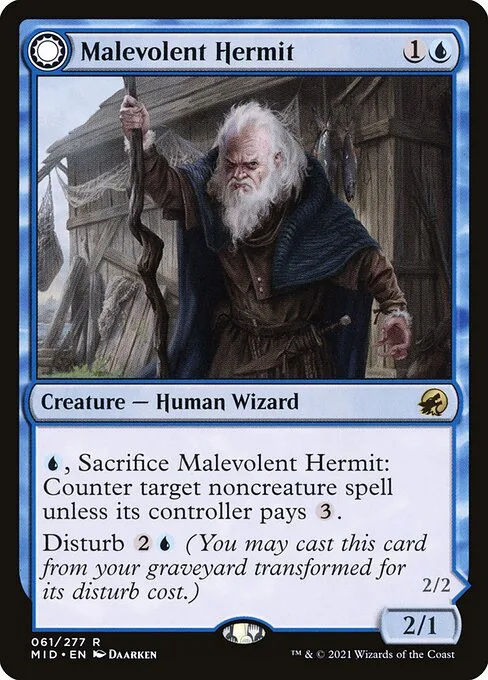

Ermitaño malévolo // Geist benévolo

Texto de la carta

Ermitaño malévolo
{U}, sacrificar el Ermitaño malévolo: Contrarresta el hechizo objetivo que no sea de criatura a menos que su controlador pague {3}.

Perturbar {2}{U}. (Puedes lanzar esta carta desde tu cementerio transformada pagando su coste de perturbar.)

Geist benévolo
Vuela.
Los hechizos que no sean de criatura que controlas no pueden ser contrarrestados.
Si el Geist benévolo fuera a ir a un cementerio desde cualquier parte, en vez de eso, exílialo.

Ofertas
Estado Idioma Foil Stock Precio Cantidad Acción Playset
Near Mint Inglés 0 1,95 
- Agotado
Near Mint Español 0 1,95 
- Agotado
Near Mint Inglés 0 1,95 
- Agotado
Near Mint Español 0 1,95 
- Agotado
Texto oficial (Oracle)

Malevolent Hermit // Benevolent Geist
Malevolent Hermit
{U}, Sacrifice this creature: Counter target noncreature spell unless its controller pays {3}.
Disturb {2}{U} (You may cast this card from your graveyard transformed for its disturb cost.)

Benevolent Geist
Flying
Noncreature spells you control can't be countered.
If Benevolent Geist would be put into a graveyard from anywhere, exile it instead.
Reglamento oficial (Oracle)
  • [2021-09-24] The back face of each card with disturb has an ability that instructs its controller to exile if it would be put into a graveyard from anywhere. This includes going to the graveyard from the stack, so if the spell is countered after you cast it using the disturb ability, it will be put into exile.
  • [2021-09-24] When you cast a spell using a card's disturb ability, the card is put onto the stack with its back face up. The resulting spell has all the characteristics of that face.
  • [2021-09-24] A spell cast this way enters the battlefield with its back face up.
  • [2021-09-24] If you copy a permanent spell cast this way (perhaps with a card like Double Major), the copy becomes a token that's a copy of the card's back face, even though it isn't itself a double-faced card.
  • [2021-09-24] Disturb is found only on the front faces of some double-faced cards.
  • [2021-09-24] To determine the total cost of a spell, start with the mana cost or alternative cost (such as a disturb cost) you're paying, add any cost increases, then apply any cost reductions. The mana value of a spell cast using disturb is determined by the mana cost on the front face of the card, no matter what the total cost to cast the spell was. (This is a special rule that applies only to nonmodal double faced-cards, including ones with disturb.)
  • [2021-09-24] "Disturb [cost]" means "You may cast this card transformed from your graveyard by paying [cost] rather than its mana cost."
Clientes que compraron este artículo también compraron...
Cartas similares

Acceder